Odiham Art Group

Odiham Art Group
Demonstration Reviews
Saturday 3 October 2026
Roger Dellar: Oils - Marine
Roger worked from a personal photograph of an active beach scene at Sea View on the Isle of Wright.
Working on a hardboard surface prepared with 3 coats of Bob Frost Gesso, Roger made a quick start laying down the darks within his composition. He likes to start with a lean application of colour that can be built up to create 'fatter' lights as the painting progresses. At this stage he is looking for abstract shapes not recognisable objects, moving across the compositional in sweeping diagonals ...
'we view paintings from the bottom left and then allow the eye to move around the image.'
Roger has a 'lazy' approach to brushes (his words not mine) preferring to wipe them with a cloth dipped in solvent and leaving them overnight in cooking oil to keep them soft and supple. He starts with a relatively small brush and moves on to even smaller brushes and a palette knife as the detail demands.
He adds splashes of warm light in shades of yellow. As a painter who works regularly en plein air he is used to capturing light very quickly before it changes and moves.
His image included a number of people both in the water and on the beach and he was careful to ensure accurate proportion and stance, noting that 'heads should be smaller than you imagine'.
In the final stages he adds lights to the rocks in the foreground bringing out their shape, cutting into the paint to bring out sharper edges and details.


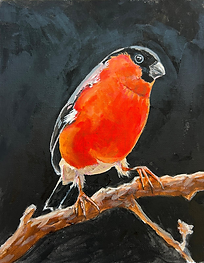
Saturday 5 September 2026 Julian Routledge: Acrylic - Birds
Julian originally studied graphic art specialising in illustration. He went on to have a career as a Creative Director before returning to traditional painting and drawing in his retirement.
As a full time artist Julian focuses most of his work on the natural world specialising in birds and big cats. He sources his subjects from a variety of places but generally works from photographs via an iPad.
His small paintings of native birds are highly stylised with a flat black background that can take 4 layers to achieve. His tools are simple and go to show that cost is not a factor to achieving excellence.
Julian starts the birds with the darkest areas which helps to define the feathers that go on the top. He pays careful attention to getting the eye right as single feature is imperative to secure the likeness. In his studio he would work on up to 4 paintings at a time but for the purposes of the demonstration he worked on 2. He likes to build up the paint over a series of thin layers using the smallest of brushes to recreate the level of detail he likes to work in.
Once finished the paintings are sealed simply with an acrylic spray varnish.



Saturday 9 May 2026
Elaine Reed: Watercolour Workshop
Elaine delivered a delightful session on mixed media, working from a sea view photograph that she provided.
Attendees were encouraged to use the provided source material or bring something of their own that would allow for the addition of wild flower vegetation in the foreground.
Elaine skillfully guided the group through a number of techniques including masking, printing from dried vegetation, ink and pens.
The outcomes were highly successful for all members who took part.


Saturday 11 April 2026
Wendy Barratt: Charcoal Portrait
Prior to winning Sky Portrait Artist of the Year 2023, Wendy had racked up a mere 30 years refining her skills as a portrait artist.
Like many portrait artists, Wendy has a passion for charcoal and graphite which she likes to use prior to any commissioned portrait. This medium helps her to train her eye for the final oil composition.
Like oil, this medium can be laid on and removed as required. These days, Wendy prefers to work in Nitram charcoal, although she recommends Willow charcoal as a good starting point.
Wendy keeps her drawing loose by holding the charcoal at the very end and using the stick to help make initial measurements. She is not slavish to measuring, as she feels that if this is overdone, it can get in the way and destroy opportunities to capture the essence of the sitter.
It was not a natural step for Wendy to cross over from charcoal to paint and to make this leap she had to teach herself how to draw in paint. Nowadays, Wendy likes to keep some of the early drawing lines in her finished painting as she believes that these early marks show the process of discovery.
'There is usually a struggle which needs to be resolved and it adds character to the finished painting ...'
At regular stages Wendy will wipe through the whole paining, softening the image as the charcoal spreads across the paper. At this stage she can go back into the work and make corrections. She likes to move across the form 'sculpting' the image as she adjusts for tone.
in the final stages Wendy switches to Willow charcoal to add details and sharpen the image.


Saturday 7 March 2026
Lisa Bartlett: Still life Oils
Lisa delivered a very relaxed and calming demo, inviting plenty of questions from the audience and inspiring many to discover, or rediscover, oils.
Lisa used a Loxley board as her surface, painted in gold acrylic and started with a brief sketch of her subject. She has a preference for Michael Harding oils paints as they provide her with the bright 'yummy colours' she enjoys.
Her subject was a small collection of vases with flowers she collected from her garden. She started the painting with the objects that were furthest away, drawing a line down the centre of the vase to aid a symmetrical drawing. Lisa enjoys the practice of mark making and likes to create a variety of marks throughout the work.
Where appropriate Lisa likes to allow the background surface to show through which she believes helps to consolidate the painting.
She was careful to ensure the stems went up into the flowers which looks more realistic but she believes that the less time spent working the flowers provides a better, looser look.


Saturday 7 February 2026
Joan Crawford: Abstract Art
Joan, a longtime member of OAG, both educated and entertained a record number of members with a very personal 'conversation' on abstract art.
She started by pointing out that the purpose of abstract art was largely to provoke ideas, 'you have to delve from within - very different from painting what you see. It means working in uncertainty.... artists are generally required to focus on the outcome, when what should really matter most, is the experience!'
A notion, I'm sure, that resonated with many members was the idea that as artists we 'go out of our way to avoid vulnerability ... fearing ridicule ...' Joan advocated that 'we need to be tolerant of one another and express something from ourselves.'
Joan worked hard to encourage us to explore our creativity in mark making, trying to turn emotions into marks. She admitted that this was not an easy step to take and would take time and practice, suggesting that we make a 'habit of making marks'.
As a group, our mark making started that afternoon as we were invited to contribute to some experimental mark making from a collection of materials that Joan supplied.
Joan's 'conversation' was totally inspiring and thought provoking with practical tips for exploring our emotions with marks, working across multiple surfaces, exploring shape, helping the viewer to move around the piece with points of interest, explore collage, materials etc
Thanks Joan, for inspiring our creativity and opening our eyes to an alternative view point.

A 'conversation with Joan

Multiple mark making exercise

Group exercise with materials supplied by Joan
Saturday 17 January 2026
Soraya French: Workshop

A small group of OAG members had the pleasure of attending a workshop led by Soraya French. The subject was seascapes in mixed media and started with an inspiring demonstration.
We were invited to work from personal reference materials with whatever mixed media products we hand. Soraya provided encouragement and support, moving us gently out of our normal, comfort zones.
It was a joyful day of painting, inspired by Soraya's passion for vibrant colour and texture - the results were fabulous.
Workshops are open to all members on a first-come-first-served basis. Prices start from £40 a session and can be found listed on our programme.
Saturday 3 January 2026
Soraya French: Mixed Media
Working from a photograph and sketches of a wildflower meadow Soraya started by adapting the photograph to introduce some deeper shades of purple to balance the composition. Soraya likes to work with a mixture of acrylic inks, water soluble crayons, gouache and acrylics in professional quality. This mixture ensures that she can achieve the layers of vibrant colour she requires. Although she does use watercolour, where appropriate, it is not stable enough during the early stages and will either lift of merge into a muddy mix.
Soraya’s working approach for demonstrations is at odds with studio style which is by nature a much slower process. In a studio, Soraya is happy to return to a painting - weeks, months or even years later where she will pick up an unfinished piece and ‘play with it’ looking for an improvement or simply an experiment … ‘I’m a risk taker and what have I got to lose’.
Soraya used Saunders Waterford, hot pressed paper and started with a light under drawing … ‘even a painting that appears lose and free can still have a bit of order’. Leaving patches of white paper to expose some of the daises, she began with some soft chalk pastels to work in the cornflowers. This was followed with purple ink that she moved about freely with a palette knife. The daisy hearts were created with small puddles of bright yellow inks before she started to introduce streaks of light greens spreading the inks to create a jumble of stems and leaves with a combination of rigger brushes, plastic cards and a 1 inch brush.
A mix of Paynes grey and phthalo blue provided pockets of darker background shapes which she balanced across her composition … ‘Tone will bring the painting to life, so you have to be brave’. In this case, the dark tones allowed the flowers to settle and not hang suspended in the air.
As the painting developed and dried Soraya introduced oil pastels and passages of paint to soften hard edges and create a cohesive impression. This was a constant process and Soraya was able to add lights, introduce titanium white acrylic paint, unearthing buds and grasses as the painting demanded. She did point out that if this was a studio piece she would wait until it was totally dry before creating a final wash of watercolour to show shadows and add the depth she would be happy with.

Early stages in the painting


Final painting as concluded in the demonstration.